By Jim Kauber
As long as we endeavor to send bullets to small targets at extended ranges, the ever-present wind will remain our most challenging nemesis. While wind can be daunting, it can be overcome with a little math.
Throughout my experience in the military, competition and teaching, I have observed four primary methods long-range shooters employ in an effort to initially adjust for the wind.
I have always believed that each wind call is an entity in and of itself. Making an adjustment based on the last impact may or may not work. If it does not, reevaluate and adjust according to your observation, then reengage. The question is how one converts an educated wind value call into a mil or MOA hold.
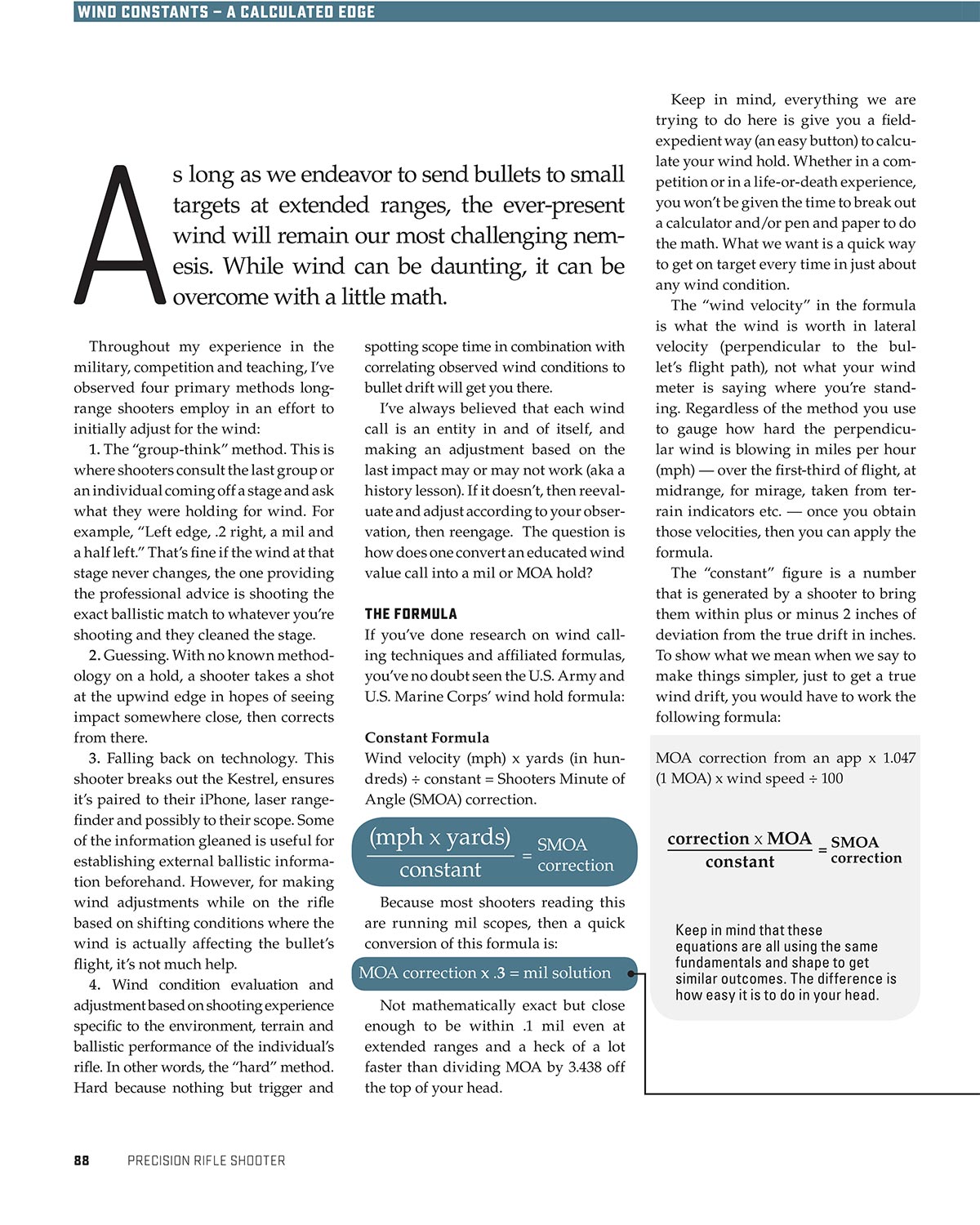
If you have researched wind calling techniques and affiliated formulas, you have no doubt seen the U.S. Army and U.S. Marine Corps wind hold formula: wind velocity in miles per hour multiplied by yards in hundreds, divided by a constant, equals a shooter's minute of angle correction.
Because most shooters reading this are running mil scopes, a quick conversion is: MOA correction multiplied by .3 equals the mil solution. It is not mathematically exact, but it is close enough to be within .1 mil even at extended ranges, and it is much faster than dividing MOA by 3.438 off the top of your head.
Keep in mind, everything we are trying to do here is give you a field-expedient way to calculate your wind hold. Whether in a competition or in a life-or-death experience, you will not be given time to break out a calculator or pen and paper to do the math. What we want is a quick way to get on target every time in just about any wind condition.
The wind velocity in the formula is what the wind is worth in lateral velocity, perpendicular to the bullet's flight path, not necessarily what your wind meter is saying where you are standing. Regardless of the method you use to gauge how hard the perpendicular wind is blowing over the first third of flight, at midrange, from mirage or from terrain indicators, once you obtain those velocities, you can apply the formula.
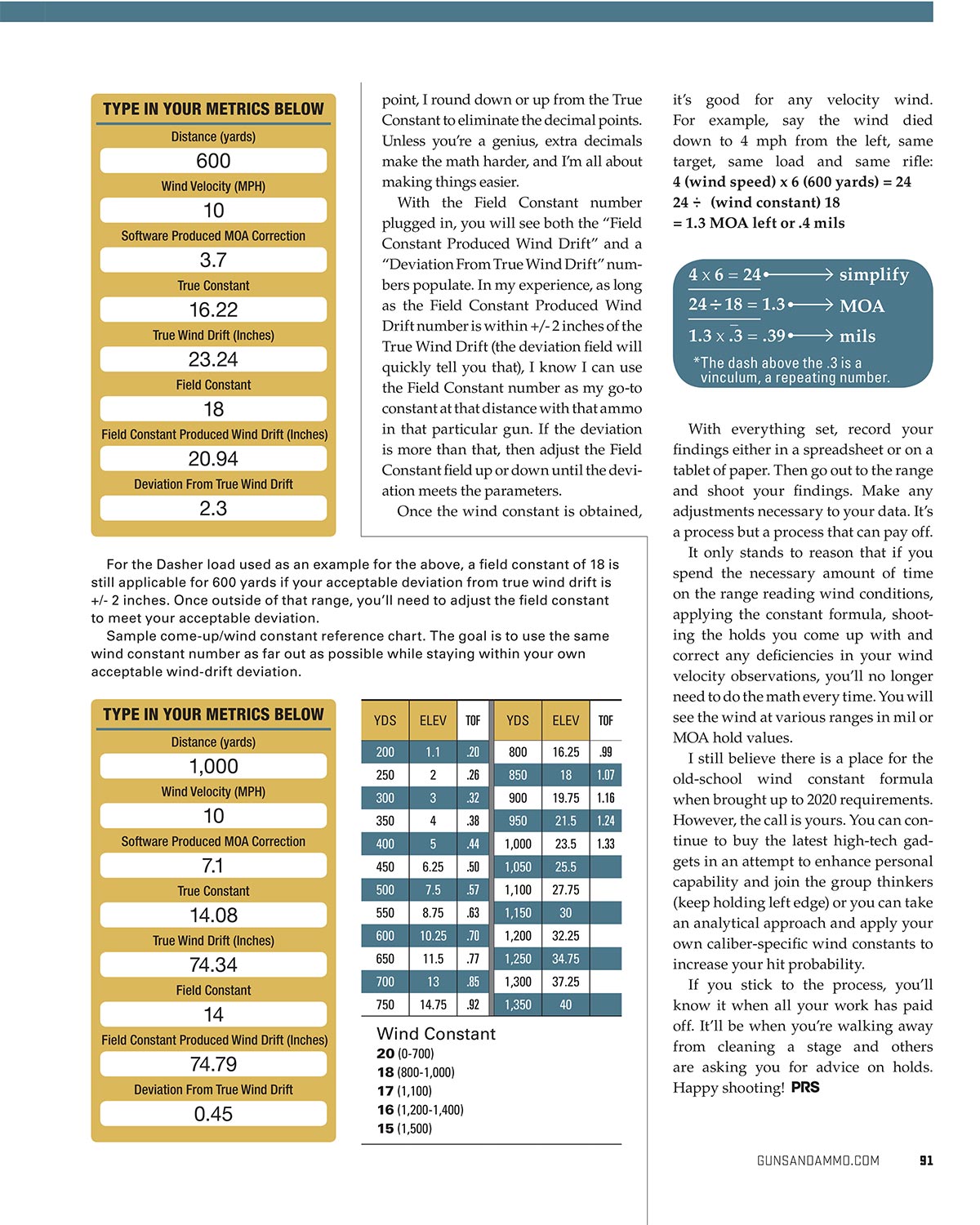
The constant is a number generated by a shooter to bring them within plus or minus 2 inches of deviation from the true drift in inches. To make things simpler, just to get a true wind drift, you would otherwise have to work a longer formula involving app-derived MOA correction, wind speed and distance.
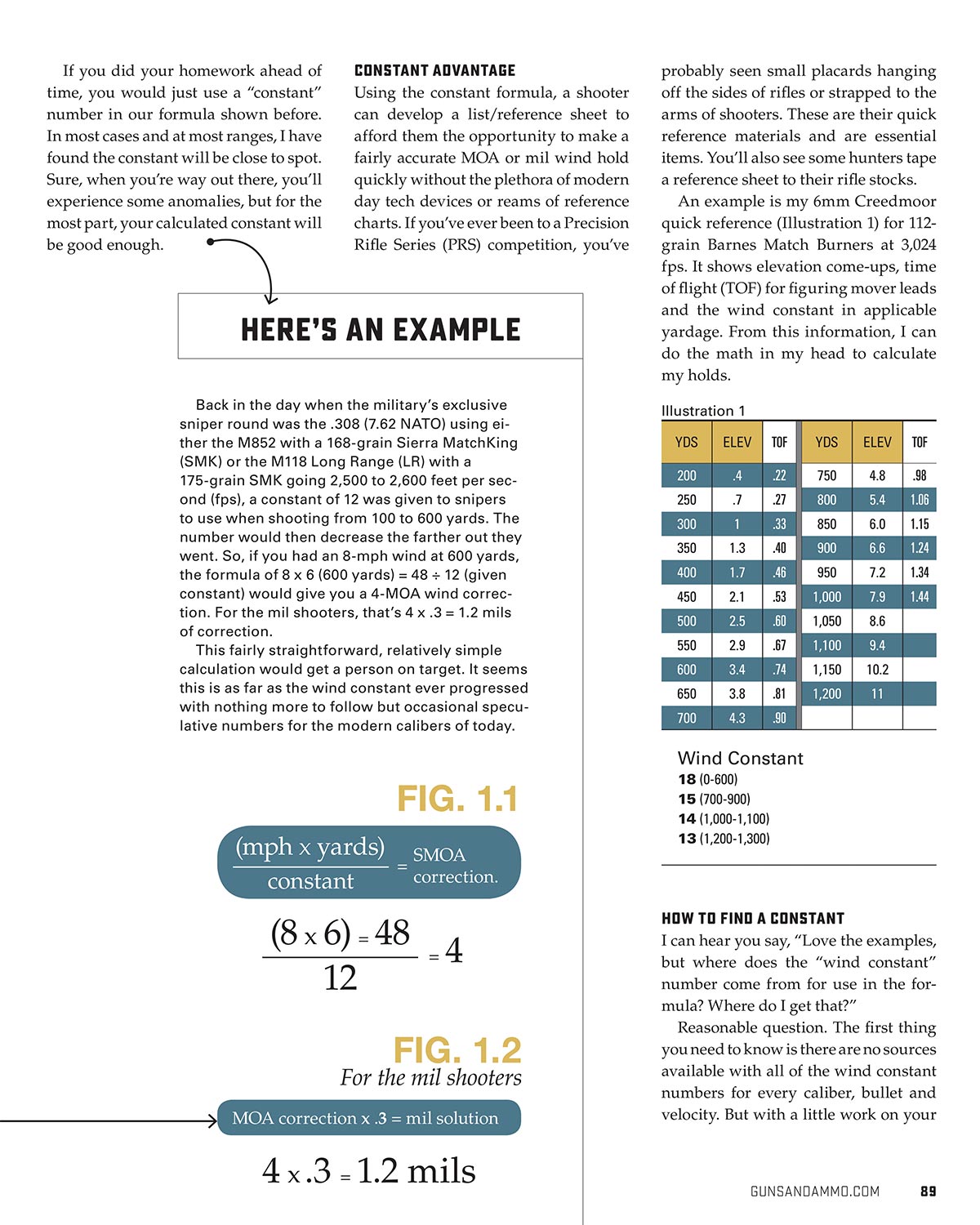
Back when the military's exclusive sniper round was the .308, using either the M852 with a 168-grain Sierra MatchKing or the M118 Long Range with a 175-grain Sierra MatchKing going 2,500 to 2,600 feet per second, a constant of 12 was given to snipers for shooting from 100 to 600 yards. The number would decrease the farther out they went.
With an 8-mph wind at 600 yards, the formula of 8 x 6 equals 48, divided by a constant of 12, gives a 4-MOA wind correction. For mil shooters, 4 x .3 gives 1.2 mils of correction.
The first thing you need to know is there are no sources available with all wind constant numbers for every caliber, bullet and velocity. With a little work, you can figure out constants for any high-speed, low-drag caliber with a reasonable degree of accuracy.
I dealt with the same question when I branched out from the .308 after leaving the Navy and started teaching precision rifle and working with Alpha Munitions. If the Army Marksmanship Unit and military sniper schools are teaching this, then it is applicable, and there must be a way to derive different constants for different projectiles and velocities.
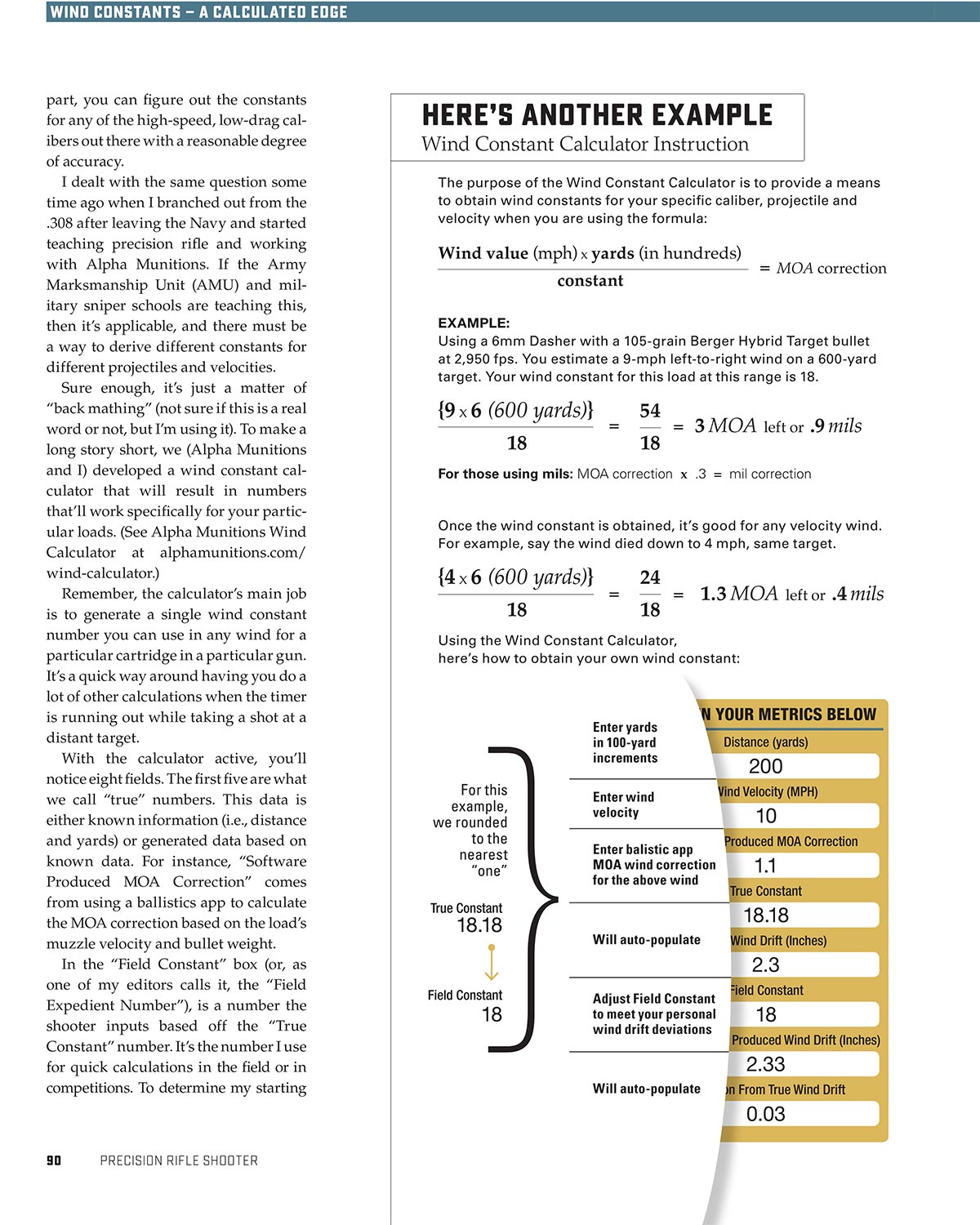
It is a matter of back math. Alpha Munitions and I developed a wind constant calculator that results in numbers that work specifically for your loads. The calculator's main job is to generate a single wind constant number you can use in any wind for a particular cartridge in a particular gun.
With the calculator active, the first fields are true numbers: known information such as distance and yards, or generated data from a ballistics app based on the load's muzzle velocity and bullet weight. The field constant is the number the shooter inputs based off the true constant number. It is the number I use for quick calculations in the field or in competitions.
Once the wind constant is obtained, it is good for any velocity wind. For example, if the wind dies down to 4 mph from the left on the same 600-yard target with the same load and rifle, 4 x 6 equals 24. Divide 24 by the wind constant of 18 and you get 1.3 MOA left, or about .4 mils.
With everything set, record your findings either in a spreadsheet or on paper. Then go to the range and shoot your findings. Make any adjustments necessary to your data. It is a process, but it is a process that can pay off.
If you spend the necessary time on the range reading wind conditions, applying the constant formula, shooting the holds you come up with and correcting deficiencies in your wind velocity observations, you will no longer need to do the math every time. You will see the wind at various ranges in mil or MOA hold values.
I still believe there is a place for the old-school wind constant formula when brought up to 2020 requirements. The call is yours. You can continue to buy the latest high-tech gadgets or take an analytical approach and apply your own caliber-specific wind constants to increase your hit probability.
This article was originally published in print.
Purchase at osgnewsstand.com