By Jim Kauber
Photos by Mark Fingar
If you hear it and repeat it enough, it has to be true. Many folks' internet-based opinion will verify it. Such is the ongoing discussion that theorizes the significant benefits in accuracy, ignition consistency, single-digit standard deviations, low extreme spreads and extended case life of small-rifle-primer brass over large-rifle-primer brass.
When I see this on the internet or on Alpha Munitions' social media sites, I wonder if the individuals are parroting the aforementioned or have actually done their own head-to-head SRP/LRP comparisons, collected the data and summarized the observed differences in an unbiased, comprehensive format. If they have, I think all the rest of us would be interested in seeing the results.
One of the great benefits of being a member of the Alpha Munitions team is having the time, resources and support to implement our own evaluation processes to any number of subjects. That brings us to the SRP/LRP data comparison. Since this seems to be a predominant subject to many in the precision rifle disciplines, especially those of us who reload, we thought it beneficial to conduct our own testing with our ultra-premium brass offered with both large and small primers.
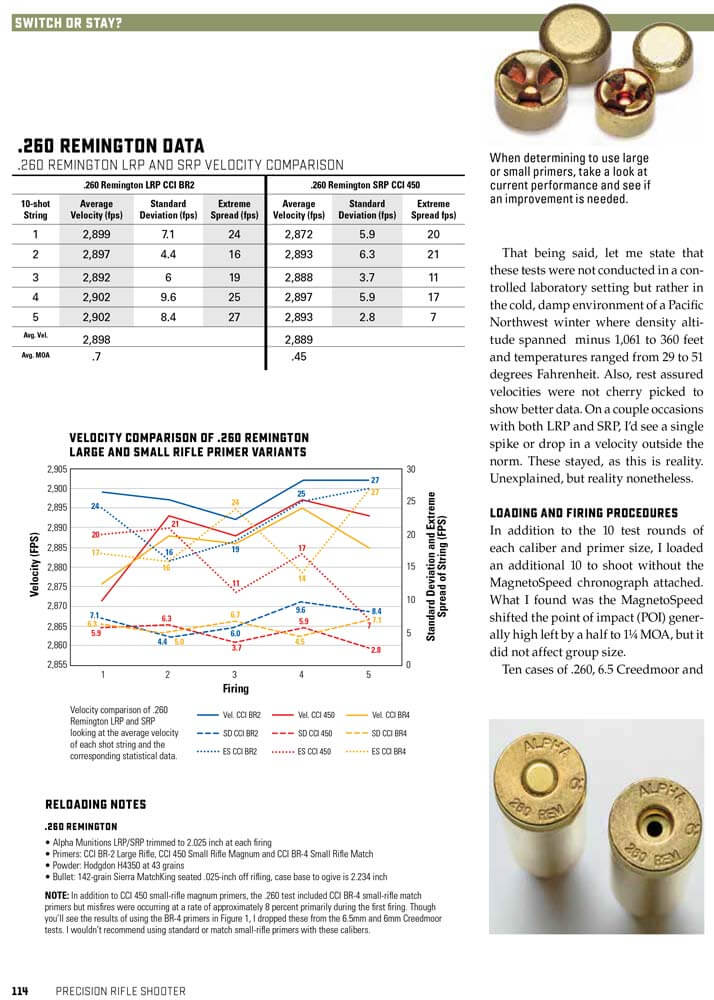
That being said, these tests were not conducted in a controlled laboratory setting but rather in the cold, damp environment of a Pacific Northwest winter where density altitude spanned minus 1,061 to 360 feet and temperatures ranged from 29 to 51 degrees Fahrenheit. Rest assured, velocities were not cherry-picked to show better data. On a couple occasions with both LRP and SRP, I would see a single spike or drop in velocity outside the norm. These stayed, as this is reality.
In addition to the 10 test rounds of each caliber and primer size, I loaded an additional 10 to shoot without the MagnetoSpeed chronograph attached. What I found was the MagnetoSpeed shifted the point of impact generally high left by a half to 1 1/4 MOA, but it did not affect group size.
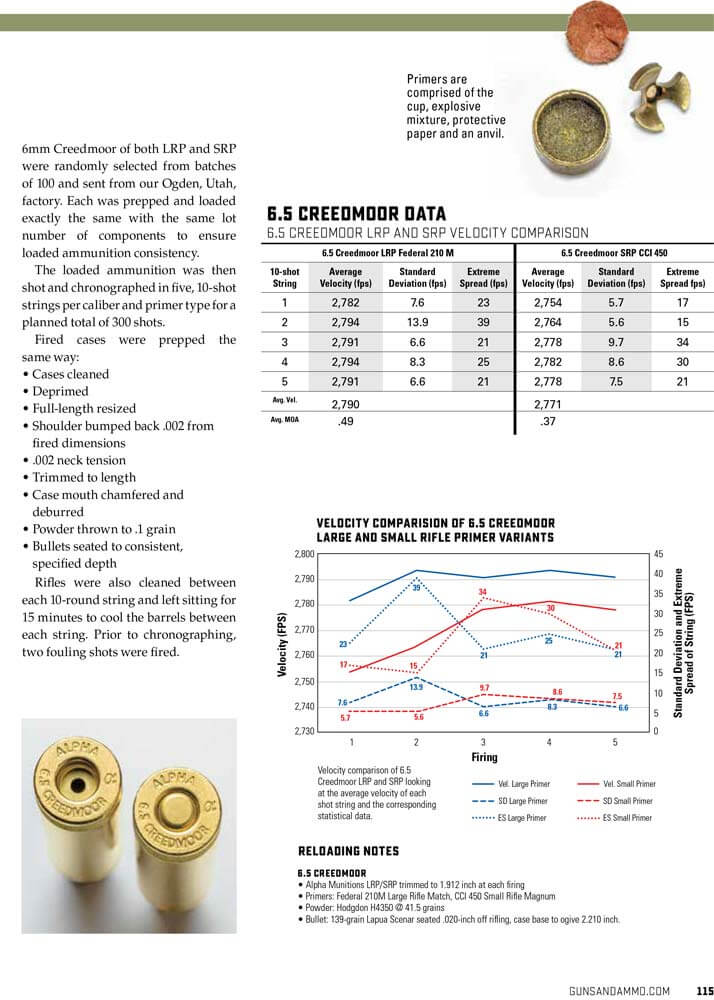
Ten cases each of .260 Remington, 6.5 Creedmoor and 6mm Creedmoor, in both LRP and SRP, were randomly selected from batches of 100 and sent from Alpha's Ogden, Utah, factory. Each was prepped and loaded exactly the same with the same lot number of components to ensure loaded ammunition consistency. The loaded ammunition was then shot and chronographed in five, 10-shot strings per caliber and primer type.
Fired cases were prepped the same way: cases cleaned, deprimed, full-length resized, shoulders bumped back .002 from fired dimensions, .002 neck tension applied, trimmed to length, case mouths chamfered and deburred, powder thrown to .1 grain, and bullets seated to a consistent specified depth.
Rifles were cleaned between each 10-round string and left sitting for 15 minutes to cool the barrels between each string. Prior to chronographing, two fouling shots were fired.
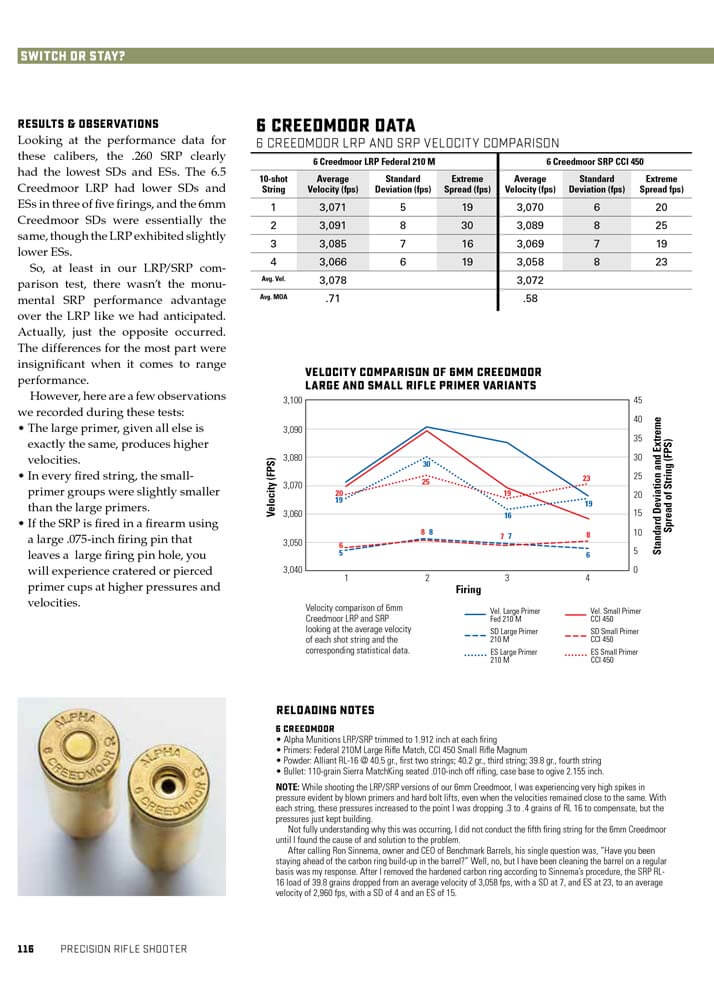
Looking at the performance data for these calibers, the .260 SRP clearly had the lowest standard deviations and extreme spreads. The 6.5 Creedmoor LRP had lower SDs and ESs in three of five firings, and the 6mm Creedmoor SDs were essentially the same, though the LRP exhibited slightly lower ESs.
At least in this LRP/SRP comparison test, there was not the monumental SRP performance advantage over the LRP that we had anticipated. Actually, just the opposite occurred. The differences for the most part were insignificant when it comes to range performance.
However, here are a few observations we recorded during these tests:
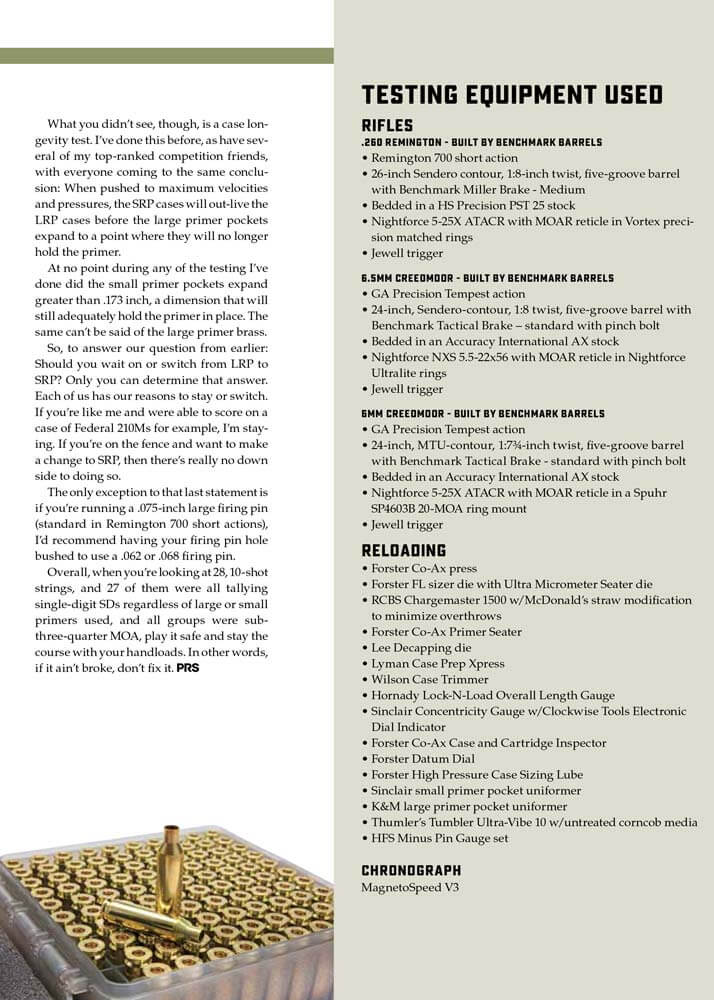
The detailed .260 Remington, 6.5 Creedmoor and 6mm Creedmoor velocity comparison tables are preserved in the original page scans below.
What you did not see, though, is a case longevity test. I have done this before, as have several of my top-ranked competition friends, with everyone coming to the same conclusion: when pushed to maximum velocities and pressures, the SRP cases will outlive the LRP cases before the large primer pockets expand to a point where they will no longer hold the primer.
At no point during any of the testing I have done did the small primer pockets expand greater than .173 inch, a dimension that will still adequately hold the primer in place. The same cannot be said of the large primer brass.
So, should you wait on or switch from LRP to SRP? Only you can determine that answer. Each of us has our reasons to stay or switch. If you are like me and were able to score on a case of Federal 210Ms, for example, I am staying. If you are on the fence and want to make a change to SRP, then there is really no downside to doing so.
The only exception is if you are running a .075-inch large firing pin, standard in Remington 700 short actions. I would recommend having your firing pin hole bushed to use a .062 or .068 firing pin.
Overall, when you are looking at 28 10-shot strings, and 27 of them were all tallying single-digit SDs regardless of large or small primers used, and all groups were sub-three-quarter MOA, play it safe and stay the course with your handloads. In other words, if it is not broken, do not fix it.
This article was originally published in print.
Purchase at osgnewsstand.com