By Jim Kauber
Photos by Alfredo Rico
The conversation is endless over whether milliradian or minute of angle is better than the other. In some circles, the debate rises to the point where it almost takes on a political fervor. I realize that perhaps 80 percent of the folks who shoot Precision Rifle Series matches use mils, but I think the MOA users may hold an advantage.
I will not get into what a mil or MOA angular measurement is worth in a 360-degree circle, as there are plenty of experts expounding on the geometrical explanation of each. Most of us, at least those who want to spend more time shooting than analyzing mathematical values to five decimals, are seeking a quick and easy method of getting rounds on target at extended ranges without having to overthink the process.
Whenever I engage others in this discussion, quick and easy is what I hear from mil users because it is easy to think in increments of 10. Fair enough. Then give me an example and explain the process you use to make a correction from a missed target.
Granted, if you see your impact in relation to the target, you can simply superimpose your reticle on the bullet strike and gauge the mil or MOA distance using your reticle to the target's center, then dial in that amount. At this point, it does not matter whether you are using mil or MOA, as each is equally effective at giving the correct intel.
But what if you are shooting movers or, because of recoil, you do not know this information, but your spotter tells you where and how far off you were?
For almost 20 years, I lived behind a mil reticle while in the U.S. Navy, beginning when our fixed 10X and 16X Leupold M1 Ultras had mil reticles and one-quarter-minute turret adjustments. It is certainly not the best combination. All it served to do was confuse us with double the mathematical effort to come up with firing or hold solutions. Over the last decade, scope manufacturers have gotten smart about the whole concept by configuring long-range optics with mil/mil and MOA/MOA reticles and corresponding turret adjustments.
When teaching Precision Rifle or DMR courses at The Site in Illinois or Bear Trap near Coalinga, California, one of the first questions asked is, "Which do you prefer, mil or minute?"
I always preface my answer with: "Look, I am not argumentative when it comes to choices like this, but primarily, I look for an immediate solution to everything I use, including the reticle and corresponding turret adjustments."
Immediate solution is based on situations where I have no time to take eyes off the target, pull out a phone or calculator, find a ballistic program or go through sheets of drop/wind charts to find a solution to the immediate ballistic discrepancy. If I know or was told by my spotter where the bullet went in inches from the center or off the edge of the target, I now have a good chance of figuring this out in my head.
Here is the question I ask the class before giving my opinion: "How many here consider themselves fairly well versed in the use of their mil or MOA system?" Usually, I will get one or two volunteers who reluctantly raise their hands.
My next question to these brave souls or the class in general is: "OK, you break a shot at a 12-inch by 12-inch moving target 600 yards away, and your spotter says your lead was good but you were 6 to 8 inches over the top of the target. Bear in mind, you only have to come down 12 inches to be fairly centered. Quickly, without consulting any written reference material or electronics, what is your mil correction to the center of the target?"
I have never been able to wrap my head around meters or centimeters. Most people reading this were never told their round went high 15.2 to 20.3 centimeters, equal to 6 to 8 inches. I usually observe a deer-in-the-headlights look from most, as no one has yet come up with the mil correction off the top of their head. I then turn to the individual with the most perplexed look and ask, "What is 12 divided by 6?" The answer is 2.
There is your correction in minutes of angle. Dial down 2 MOA, keep your same lead and you will finish the stage with 9 of 10 on the mover. My goal is to always look for the most direct field solution to any problem and come up with a way to articulate the results to those I am teaching or working with.
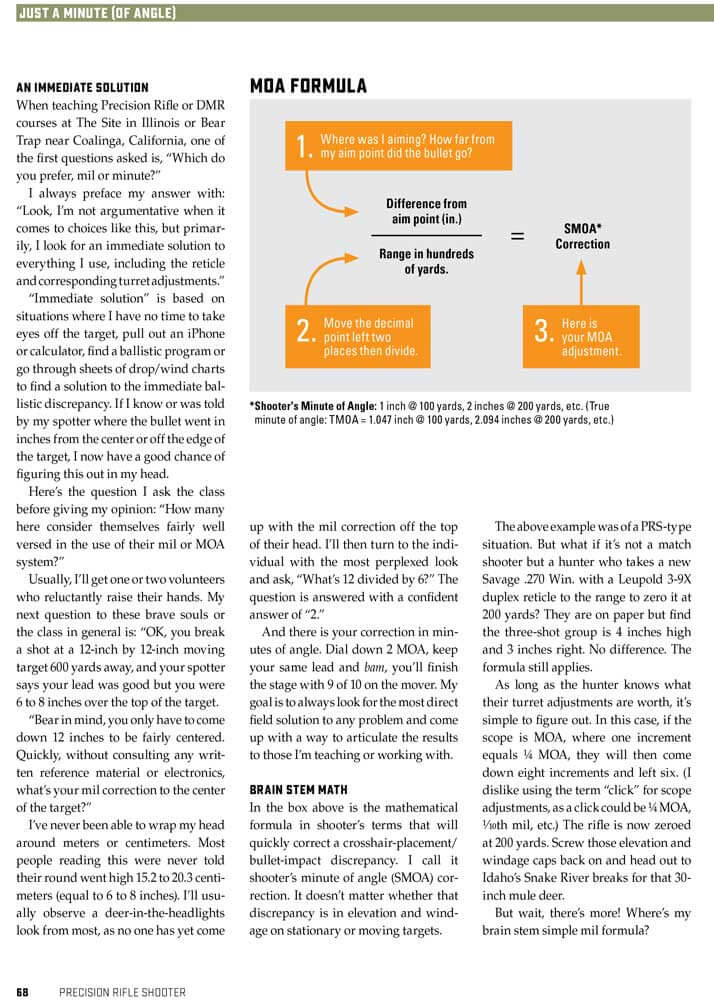
The mathematical formula in shooter's terms quickly corrects a crosshair-placement or bullet-impact discrepancy: difference from aim point in inches divided by range in hundreds of yards equals shooter's minute of angle correction. It does not matter whether that discrepancy is in elevation or windage, on stationary or moving targets.
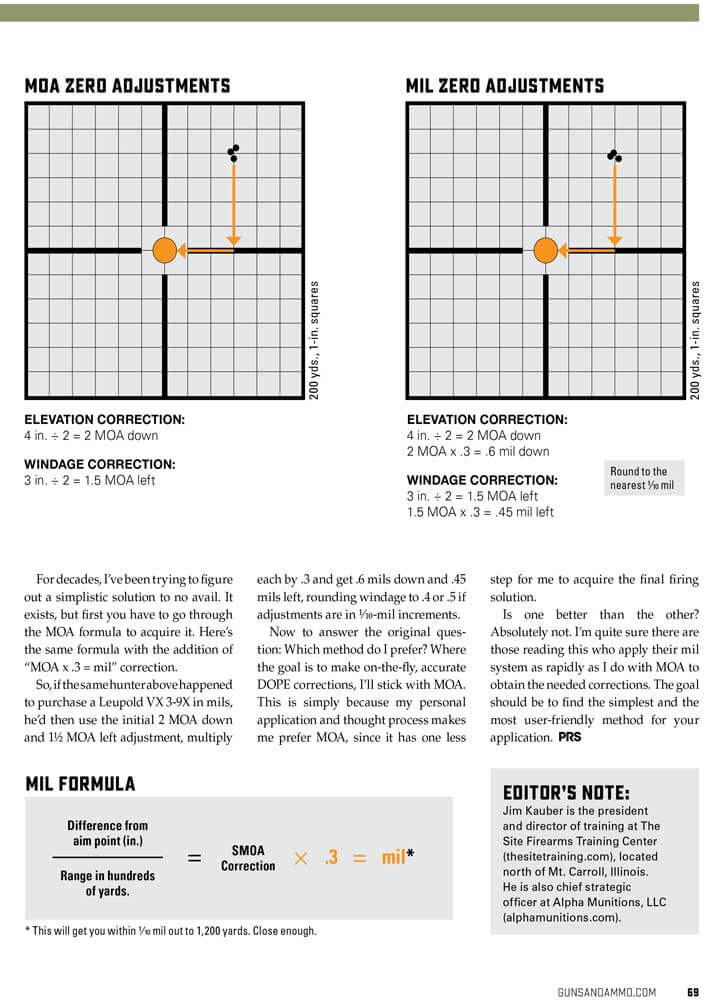
The example above was a PRS-type situation. But what if it is not a match shooter but a hunter who takes a new Savage .270 Win. with a Leupold 3-9X duplex reticle to the range to zero it at 200 yards? They are on paper but find the three-shot group is 4 inches high and 3 inches right. No difference. The formula still applies.
As long as the hunter knows what the turret adjustments are worth, it is simple to figure out. In this case, if the scope is MOA, where one increment equals 1/4 MOA, they will come down eight increments and left six. The rifle is now zeroed at 200 yards. Screw those elevation and windage caps back on and head out to Idaho's Snake River breaks for that 30-inch mule deer.
For decades, I have been trying to figure out a simplistic mil solution. It exists, but first you have to go through the MOA formula to acquire it. Use the initial MOA adjustment, then multiply by .3 to get the mil correction. The goal is to make on-the-fly, accurate DOPE corrections.
Which method do I prefer? Where the goal is to make quick, accurate corrections, I will stick with MOA. This is simply because my personal application and thought process makes me prefer MOA, since it has one less step for me to acquire the final firing solution.
Is one better than the other? Absolutely not. I am quite sure there are those who apply their mil system as rapidly as I do with MOA to obtain the needed corrections. The goal should be to find the simplest and most user-friendly method for your application.