By Jim Kauber
Photos by Andrew Rixon and Dakota Eldridge
If the shooting industry lived in the Wayback Machine, we would still expound the benefits of the .308 as the best long-range cartridge to 1,000 yards, the .300 Win. Mag. and .338 Lapua as the ultimate extreme long-range cartridges, and the .30-06 or .270 as the best you can do for Western hunting.
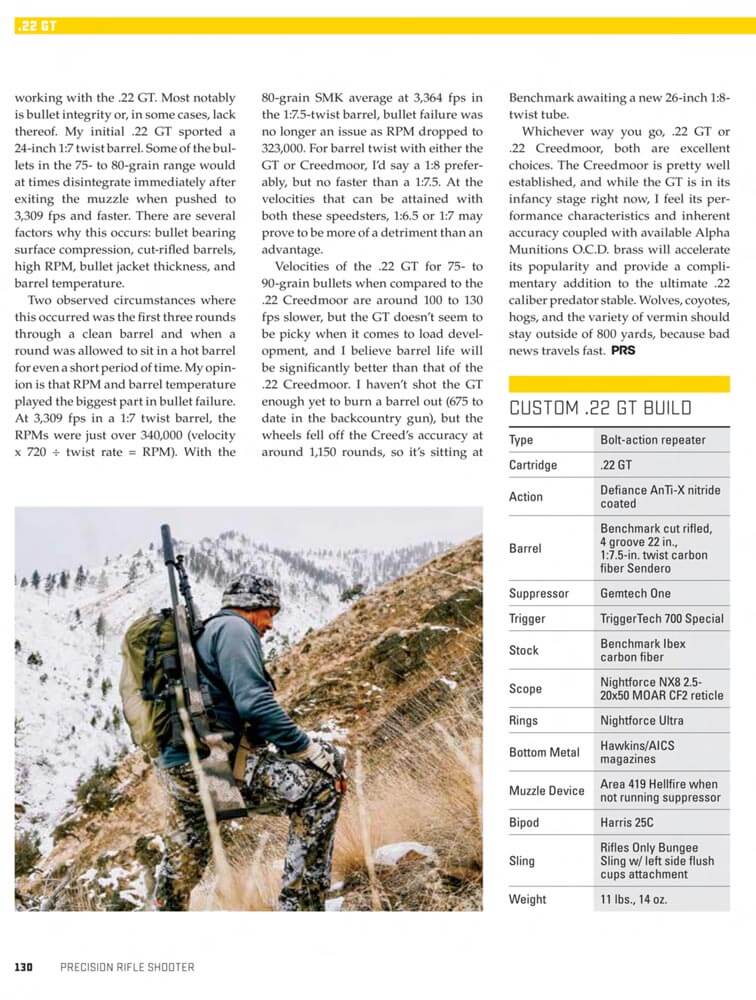
Luckily, this has not been the case. Modern cartridge designs have filled nearly every shooting niche except varmint and predator hunting. Here, hunters have been relegated to largely the same .22-caliber offerings that have existed for decades: the .223, .22-250, and .220 Swift. Things changed in 2014 when the 6mm Creedmoor was necked down to become the .22 Creedmoor.
The .22-250 and .220 Swift are fast cartridges. Both send 50-grain varmint bullets through a 1:12-inch-twist barrel at 3,800 to 4,000 fps, which does well out to 400 yards. After that, the low ballistic coefficient of these lightweight bullets hampers performance.
Out of a 1:8-twist .22 Creedmoor, 75- to 90-grain bullets cooking at 3,300 to 3,550-plus fps leave the lightweight bullets far behind in every aspect: retained velocity, energy, trajectory, and wind drift. The .22 Creedmoor has been around long enough that there is plenty of good information on rifle build specifications and load data. One could ballistically justify the .22 Creedmoor as the alpha male of the .224 predator cartridges, thus the only high-speed .22 you will ever need.
However, it was inevitable that when George Garner and Tom Jacobs introduced the now widely accepted 6mm GT to the PRS competition world, it would not take long before the case would be necked down to .22 caliber, giving birth to the .22 GT.
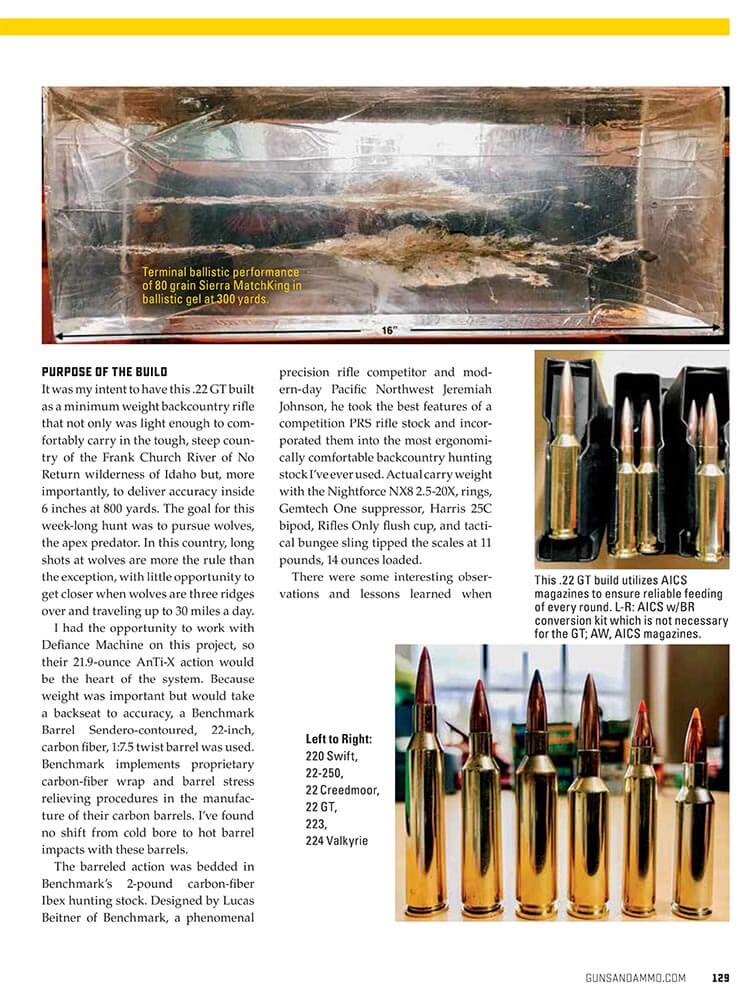
Alpha Munitions was providing quality 6 GT brass to GA Precision and foresaw the potential in further popularizing the cartridge as another excellent option for predators or medium game. The .22 GT would possess the same attributes of the 6 GT: inherently accurate, reliable feeding from unmodified AICS and AW magazines, properly head-stamped brass, appropriate case-fill volume for high and consistent velocities, and longer barrel life than the .22 Creedmoor.
Alpha Munitions designed its .22 GT Legacy Reamer with a choice of .120 or .169 freebore. The latter allows long, heavy bullets to be seated out far enough to avoid intruding on the internal volume of the case. Since the overall case length is 1.72 inches, long bullets can be seated as far out as desired without coming close to the maximum AW/AICS loaded round length of 2.880 inches. A Sierra 90-grain MatchKing seated .020 off the rifling in a .169 freebore chamber has an overall cartridge length of 2.563 inches, which means an AICS or AW spacer conversion kit is not required to ensure reliable feeding.
Alpha then developed O.C.D. (Optimized Cartridge Design) brass, boasting superior primer pocket longevity, minimal case stretch, and improved pressure containment through proprietary measures that increase case hardness in specific areas without compromising case malleability where it counts. The primary advantage of O.C.D. brass is its ability to contain higher pressures with correspondingly higher velocities while masking classic pressure indicators such as stiff bolt lift, flattened or blown primers, ejector marks, and extractor swipe marks.
As with the .22 Creedmoor, the advantage of this cartridge is shooting heavy-for-caliber bullets in quick-twist barrels at high speed. Slower-burning powders such as H4350, RL-16, RL-23, and RL-26 work best because their peak-pressure curve is longer, producing higher velocities with less pressure than faster-burning powders such as Varget.
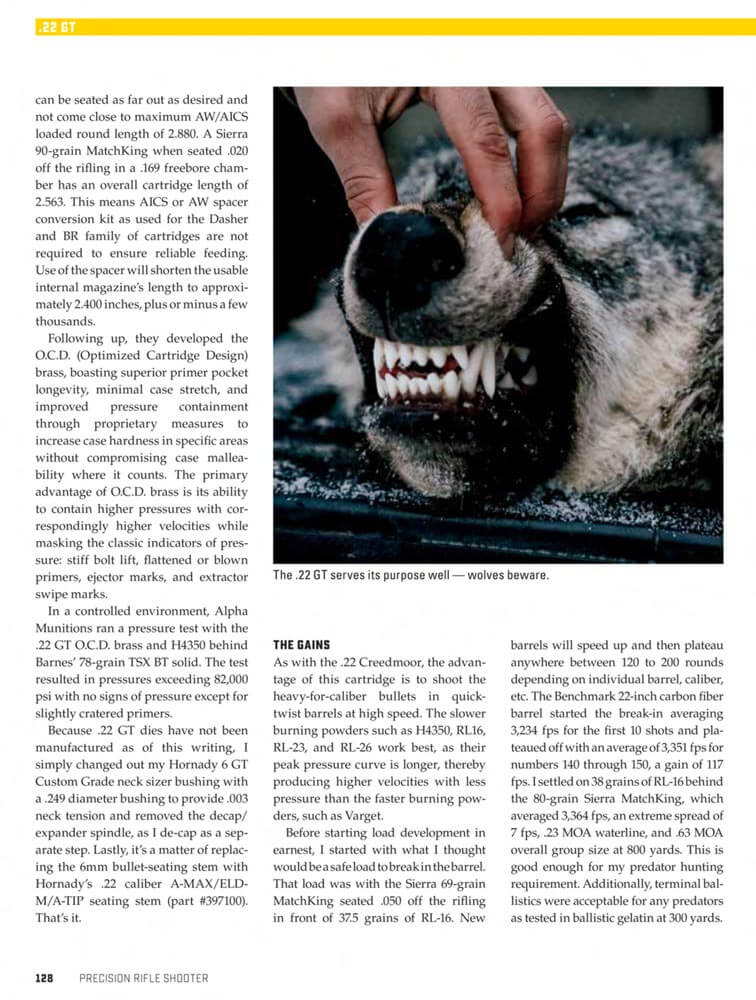
Before starting load development in earnest, I began with what I thought would be a safe load to break in the barrel. The Benchmark 22-inch carbon-fiber barrel started the break-in averaging 3,234 fps for the first 10 shots and plateaued with an average of 3,351 fps for shots 140 through 150, a gain of 117 fps. I settled on 38 grains of RL-16 behind the 80-grain Sierra MatchKing, which averaged 3,364 fps, with an extreme spread of 7 fps, a 2.3 MOA waterline, and a 6.3 MOA overall group size at 800 yards. This was good enough for my predator-hunting requirement.
It was my intent to have this .22 GT built as a minimum-weight backcountry rifle that was light enough to carry in the tough, steep country of the Frank Church River of No Return Wilderness of Idaho, but more importantly, to deliver accuracy inside 6 inches at 800 yards. The goal for this week-long hunt was to pursue wolves, the apex predator. In this country, long shots at wolves are more the rule than the exception, with little opportunity to get closer when wolves are three ridges over and traveling up to 30 miles a day.
I had the opportunity to work with Defiance Machine on this project, so their 21.9-ounce AnTi-X action would be the heart of the system. Because weight was important but would take a backseat to accuracy, a Benchmark Barrel Sendero-contoured, 22-inch, carbon-fiber, 1:7.5-twist barrel was used. The barreled action was bedded in Benchmark's 2-pound carbon-fiber Ibex hunting stock.
Designed by Lucas Beitner of Benchmark, a phenomenal precision-rifle competitor and modern-day Pacific Northwest Jeremiah Johnson, the stock takes the best features of a competition PRS rifle stock and incorporates them into the most ergonomically comfortable backcountry hunting stock I have ever used. Actual carry weight with the Nightforce NX8 2.5-20X, rings, Gemtech One suppressor, Harris 25C bipod, Rifles Only flush cup, and tactical bungee sling tipped the scales at 11 pounds, 14 ounces loaded.
There were some interesting observations and lessons learned when working with the .22 GT. Most notably, bullet integrity or, in some cases, the lack thereof. My initial .22 GT sported a 24-inch 1:7-twist barrel. Some bullets in the 75- to 80-grain range would at times disintegrate immediately after exiting the muzzle when pushed to 3,309 fps and faster. Several factors can cause this: bullet bearing-surface compression, cut-rifled barrels, high RPM, bullet jacket thickness, and barrel temperature.
Two observed circumstances where this occurred were the first three rounds through a clean barrel and when a round was allowed to sit in a hot barrel for even a short period of time. My opinion is that RPM and barrel temperature played the biggest part in bullet failure. At 3,309 fps in a 1:7-twist barrel, RPM was just over 340,000. With the 80-grain SMK averaging 3,364 fps in the 1:7.5-twist barrel, bullet failure was no longer an issue as RPM dropped to about 323,000. For barrel twist with either the GT or Creedmoor, I would say 1:8 is preferable, but no faster than 1:7.5.
Velocities of the .22 GT for 75- to 90-grain bullets, when compared to the .22 Creedmoor, are around 100 to 130 fps slower, but the GT does not seem to be picky when it comes to load development, and I believe barrel life will be significantly better than that of the .22 Creedmoor.
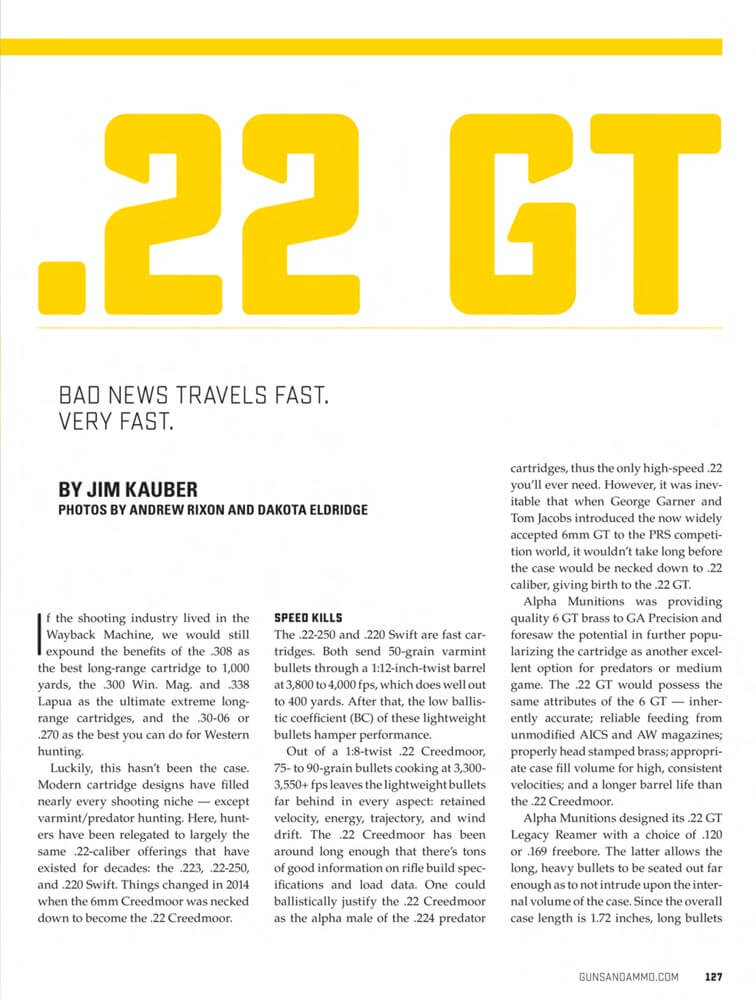
Whichever way you go, .22 GT or .22 Creedmoor, both are excellent choices. The Creedmoor is pretty well established, and while the GT is in its infancy stage right now, I feel its performance characteristics and inherent accuracy, coupled with available Alpha Munitions O.C.D. brass, will accelerate its popularity and provide a complementary addition to the ultimate .22-caliber predator stable. Wolves, coyotes, hogs, and the variety of vermin should stay outside of 800 yards, because bad news travels fast.